Thirty Years Of One Technology, Deepening.
The story of Modernize Software is the story of how one toolkit evolved. Not a client list, a capability arc.
ABOUT MODERNIZE SOFTWARE
Modernize Software is the modernization practice of Semantic Designs, the Austin-based software engineering firm operating since 1995. Same people. Same toolkit. Same standards. We move legacy systems off the mainframe and other legacy technologies onto modern stacks with 100% functional equivalence, in months rather than years.
That's the elevator pitch. The rest of this page explains how.
Semantic Designs, Inc. was founded in Austin in 1995 by Dr. Ira Baxter, a computer scientist with a PhD from UC Irvine and a career in program transformation that started in the 1970s. The goal: build commercial-grade tools for the large-scale software analysis and transformation that academic research had been describing for decades but nobody had productized.
Three decades later, the company runs on the same foundation. Symbolic AI program analysis. Mathematically defined rewrite rules. Gen AI assisted ruling. Deterministic transformation. We’ve worked with Fortune Global 500 companies and US government agencies on systems where a translation error costs lives, money, or both.
In 2012, Semantic Designs won a $1M Department of Energy SBIR Phase II grant, one of only four awarded to Texas-based companies that year. The technical depth has always been there.
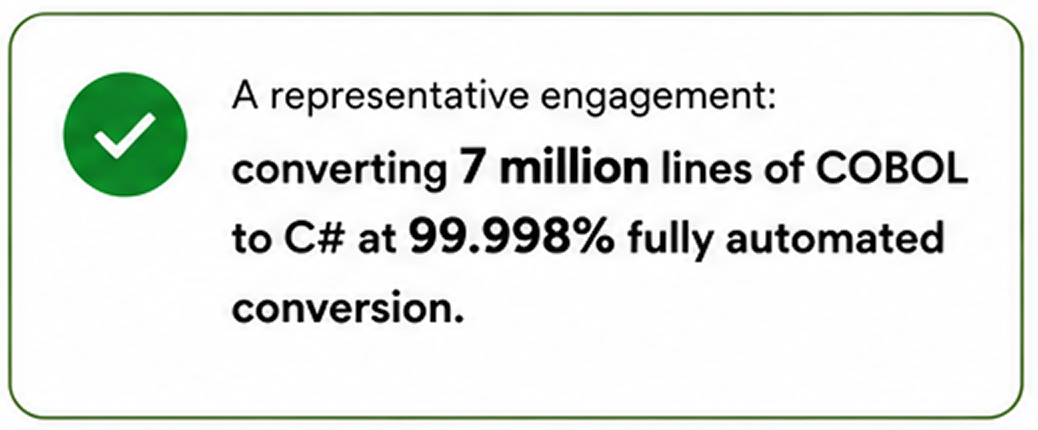
Modernize Software is a division of Semantic Designs, Inc. It has been carrying out large-scale source code analysis and modernization for common languages (COBOL) and arbitrary computer languages (ColdFusion), along with the surrounding legacy technology ecosystems (databases, screens, messaging, architectures), since 1995. Modernize uses SD's proprietary DMS system, a set of highly configurable tools for automating this work. A representative engagement: converting 7 million lines of COBOL to C# at 99.998% fully automated conversion.
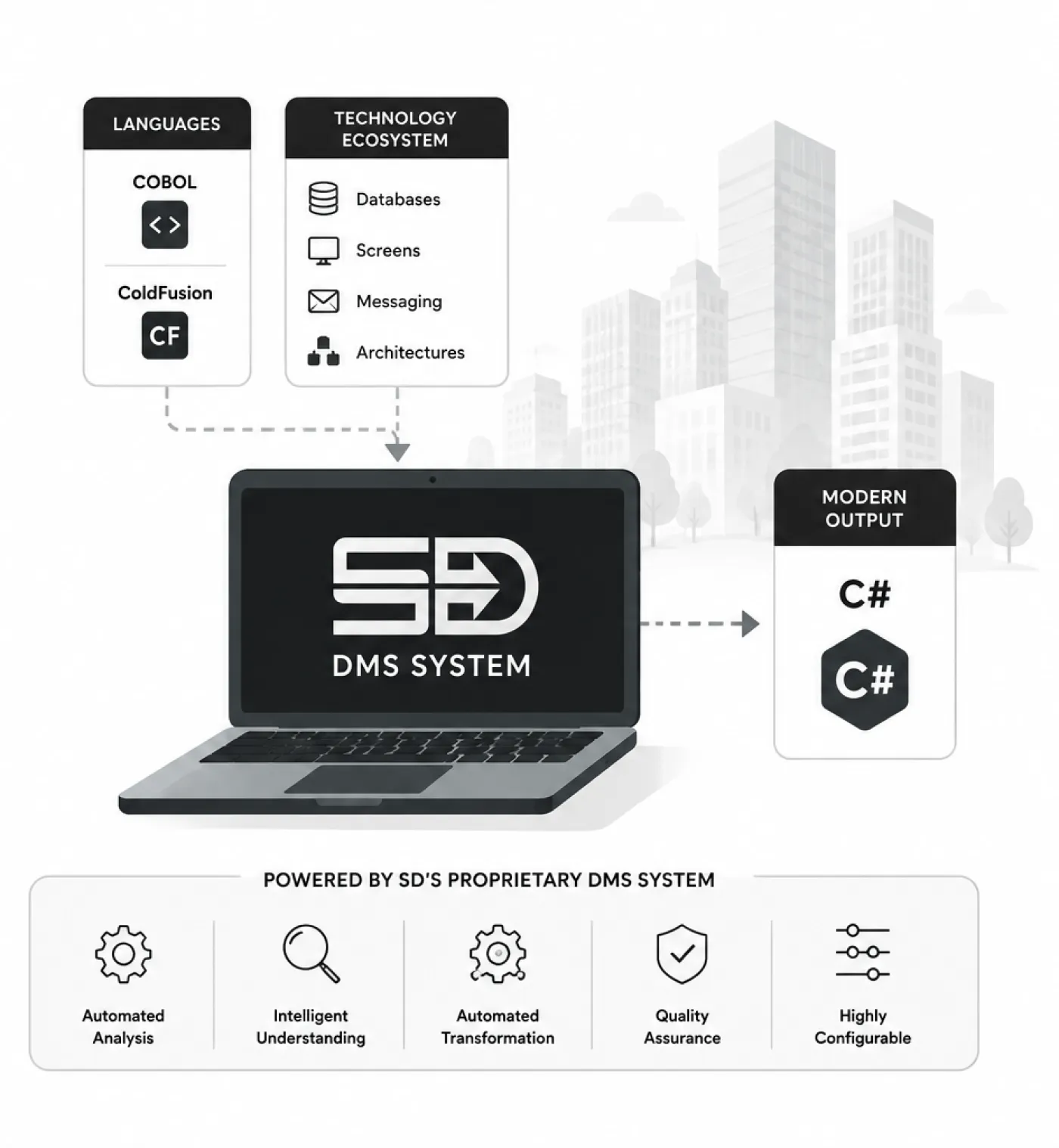
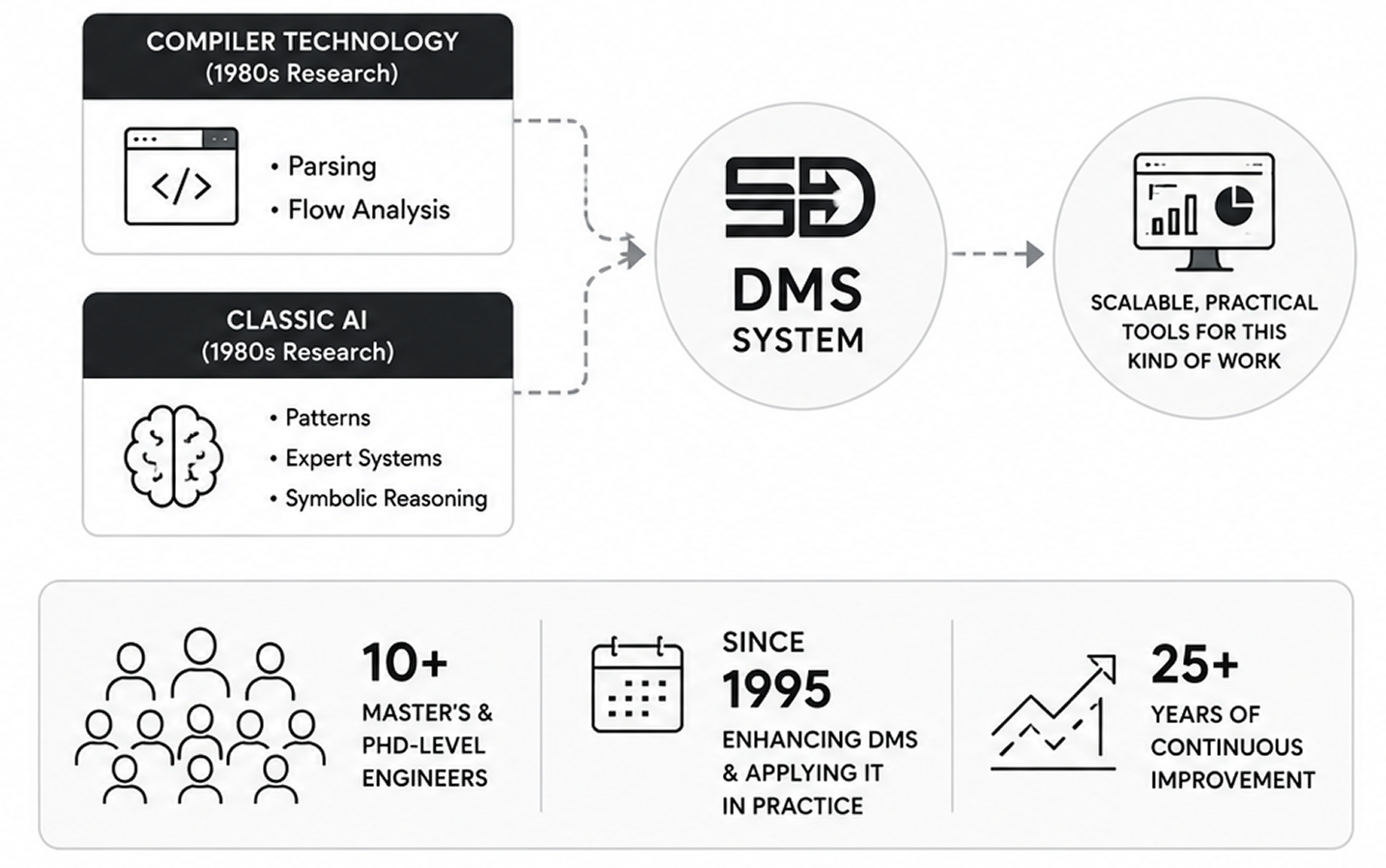
DMS is based on Dr. Baxter's PhD research in compiler technology (parsing, flow analysis) and classic AI (patterns, expert systems, symbolic reasoning) from the 1980s, which showed how to build scalable, practical tools for this kind of work. A team of 10 Master's and PhD-level engineers has been enhancing the DMS technology and applying it in practice since 1995. DMS continues to be enhanced, including newer AI technology that speeds DMS configuration and helps engineers understand legacy architectures.
Semantic Designs has been providing software modernization solutions since its first commercial engagement in 1997. By 2026, the market had evolved enough to warrant a dedicated software modernization practice, and Modernize Software was established as a division of Semantic Designs.
Advancements in AI have opened a new range of possibilities for modernization initiatives. However, large-scale efforts continue to face challenges with AI hallucinations, making deterministic audit trails essential for systems where compliance, accuracy, and preservation of business rules are critical.
Modernize Software is how Semantic Designs brings that combination of deterministic transformation and AI-accelerated modernization to market.
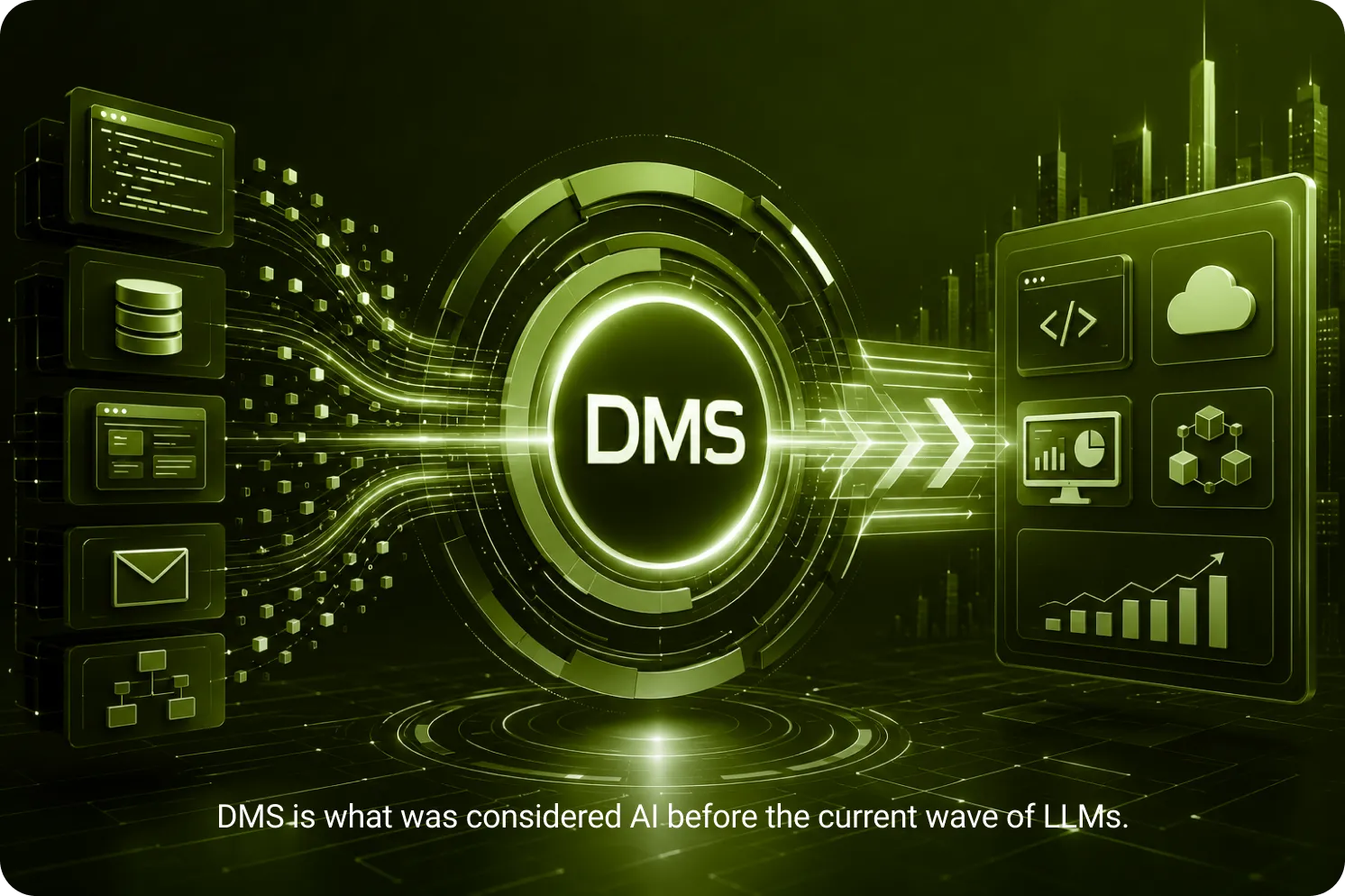
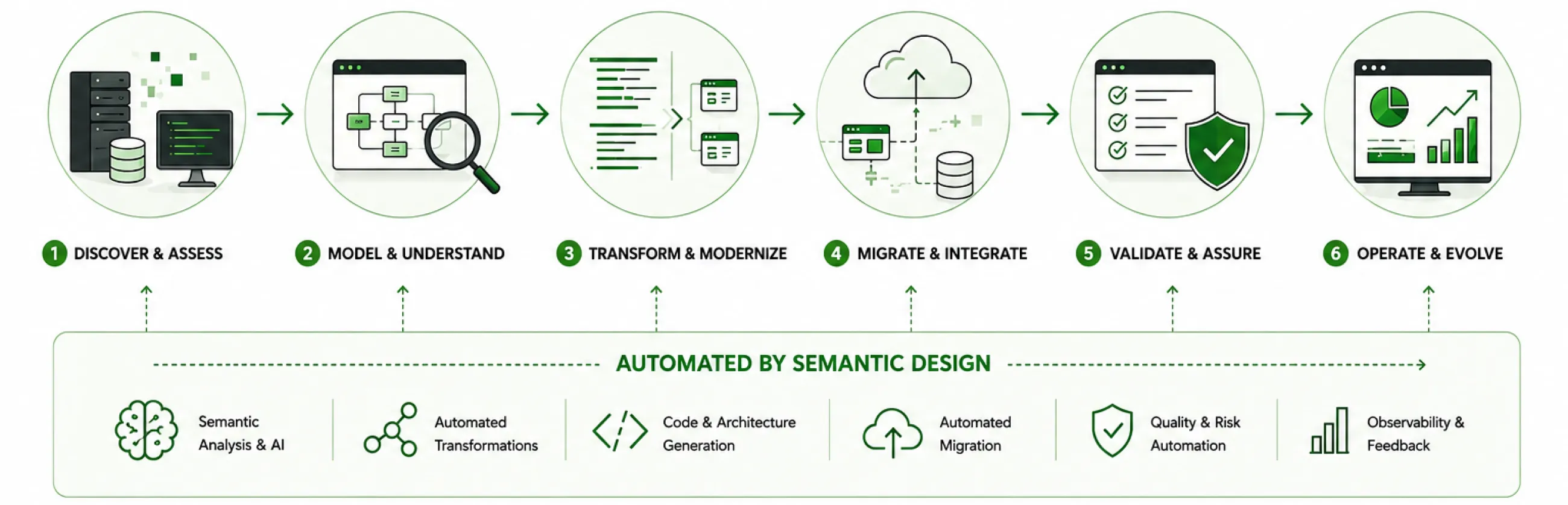
The DMS Software Reengineering Toolkit is the engine behind every Modernize Software engagement. It fuses symbolic AI with enhanced compiler technology: it parses source code into abstract syntax trees, runs control-flow and data-flow analysis, applies mathematically defined rewrite rules, and emits the target language.
The story of Modernize Software is the story of how one toolkit evolved. Not a client list, a capability arc.
Foundations. Dr. Baxter's PhD research combines compiler technology (parsing, flow analysis) with classic AI (patterns, expert systems, symbolic reasoning). The blueprint for scalable, practical transformation tools.
DMS productized. Semantic Designs founded in Austin. Symbolic AI and compiler technology become a commercial toolkit, not an academic idea.
Language breadth. Grammar front-ends expand toward 40+ languages and dialects, including 13 COBOL dialects and the mainframe ecosystem: CICS, IMS, VSAM, JCL, HLASM.
Proven at scale. DMS handles codebases in the tens of millions of lines. Custom 4GL grammars added in weeks for languages that exist nowhere else.
AI-augmented. GenAI runs alongside DMS for business rule extraction and documentation, speeding configuration and architecture comprehension. The deterministic core stays in control.
Modernize Software launches. A dedicated practice for mainframe and legacy modernization. Same team. Same toolkit. New name on the door.
Four operating principles that show up in every engagement.
Deterministic transformation produces the same output every run. AI translation produces something different every run.
For systems where errors are recoverable, AI is fine. For systems where they aren't, determinism is the only honest answer.
When you call us, you talk to the symbolic AI engineer who’ll configure DMS for your dialect.
Not a sales development rep. Not an account executive with a script. The technical conversation starts on call one.
Once we’ve inventoried your code and scoped the work, the commitment is fixed.
If we miss the estimate, that’s our cost, not yours. Time-and-materials after the assessment shifts risk onto the buyer. We don’t do that.
Four scenarios make us recommend something else: active feature development, low annual maintenance, an off-the-shelf replacement coming, or a stable team with no immediate risk.
We’d rather skip your engagement than land a project that shouldn’t have been started.
The 100% project success rate isn't a marketing claim. It's a count. Every paid engagement Semantic Designs has signed since 1995 has delivered the contracted output.
Small, senior, technical. The leadership team is involved in
every engagement, not just the
contract signing.
Principal architect of DMS. Active in program transformation since the 1970s.
PhD in Computer
Science from UC Irvine.
Founded his first compiler company, Software Dynamics, in 1976.
Wrote the
foundational 1992 CACM paper on Design Maintenance Systems that DMS is built on. Principal
designer
of PARLANSE, a parallel programming language, and architect of CloneDR, the AST-based clone
detection
technology now used across multiple commercial tools.
Principal engineer of DMS, SD's core transformation and analysis infrastructure,
since 1996.
Lead architect of the HLASM, C, C++, and COBOL front ends.
Lead engineer on fully
automated code
migrations for real-time and mainframe systems, including JOVIAL to C, HLASM to Metal C, and
SabreTalk to C. Lead architect on mainframe COBOL and Assembler migration tooling and on multiple
C++ refactoring projects. Specialist in data-flow-based business idiom recognition.
Bridges the design and construction of programming systems with formal
specification and
analysis
of programs, across academic and industrial research.
At UT Austin he led a team
building program analysis tools used by the National Computer Security Center. At MCC he led a
team building tools for computational linguists. At Computational Logic he built an executable
semantic model of the Java Virtual Machine for Sun Microsystems. At EDS he built tools that
analyzed and transformed over 35 million lines of COBOL and a framework that ported dozens of
applications from mainframe to Java on Unix.
Since joining Semantic Designs, he has managed delivery of language analysis tools for Java,
COBOL, IBM Assembler, and OS/JCL. BA in Mathematics, Columbia University. PhD in Computer Science,
UT Austin. Certified ScrumMaster.
Modernize Software is staffed by Semantic Designs engineers writing DMS rewrite rules. Most have advanced degrees in computer science. We stay small and take six enterprise engagements per year. When you hire us, you get the people who built the engine.
A subset of public engagements. Defense, financial services, and government work is mostly under NDA and not listed here.















The team operates from Austin, supplemented by remote engineers
across the US. We're not a
body-shop operation. The DMS toolkit runs in
CPU hours, not headcount, so most of the work
happens in our office
and shows up as code in your repository.
For classified, regulated, or simply cautious environments, the DMS toolkit deploys on your
infrastructure with no source code or output leaving your network.
We’ve done this for defense, banking, and government clients. Your security team audits every
component.
Every engagement starts with a mutual NDA. Your code, your specifications, and your business
rules stay confidential.
We’ve signed NDAs with Fortune 500 companies, US government agencies, and international banks.
The paperwork is fast.
Every engagement starts the same way, with a free
assessment. From there, two delivery
models,
picked to fit
your team's capacity.
We own the modernization end to end: assessment, DMS configuration, translation, verification,
and cutover support.
You receive working, verified code in your repository.
Right when you want the result without standing up an internal program.
A collaborative engagement where your team takes on the roles that fit you: infrastructure
setup, environment management, test execution, domain validation.
We own the DMS translation core. You own the parts you want to keep in-house.
Lowers cost and builds internal capability for the long run.
.png)

 info@semanticdesigns.com
